

Law Firm Website Design
A prospective client who finds a firm through Google, through a referral, or through an AI assistant will visit that firm’s website before picking up the phone. The visit lasts seconds, not minutes, and the decision it produces is binary: this firm feels right, or it does not. Law firm website design is the discipline that controls whether a site earns contact or loses it, and the gap between a site that converts and one that simply exists is almost always structural, not cosmetic.
The distinction matters because law firms are not selling a product with a spec sheet. A person searching for a criminal defense attorney after an arrest, a spouse researching divorce lawyers at midnight, or a business owner facing a contract dispute is making a trust decision under stress. The site has to answer an emotional question, not just an informational one, and it has to do so on a phone screen in under three seconds. That is why law firm website design is a specialization rather than a flavor of general web development. The visual language, page architecture, intake pathways, compliance constraints, and conversion psychology all differ from what works in e-commerce, SaaS, or healthcare.
Where firms lose money is not in choosing the wrong color palette. They lose it by treating a website as a finished product rather than as an evolving system that has to perform across organic search, paid search, AI retrieval, and direct traffic simultaneously. The site has to satisfy Google’s crawlers, answer the questions ChatGPT pulls from when recommending attorneys, load fast enough to hold an impatient visitor, and still read as credible to a person deciding whether to trust a stranger with a life-altering problem. MileMark builds law firm websites within that full set of constraints, which is the reason every site MileMark produces is a custom WordPress build rather than a themed template with a firm’s name swapped in.
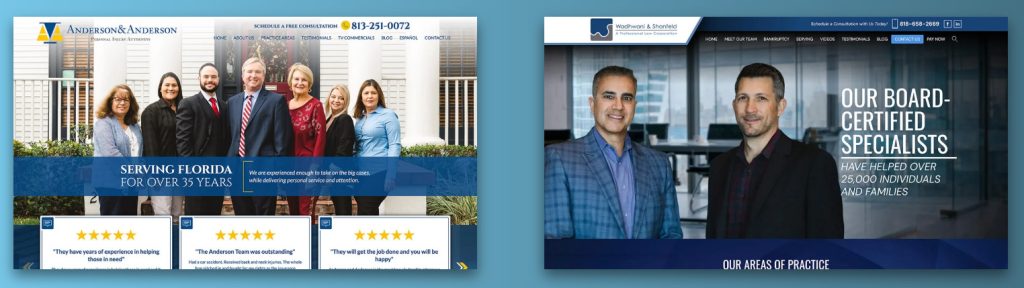
How Prospective Clients Actually Find and Choose Law Firms Now
Search behavior has fractured. Five years ago, a person needing a lawyer would type a short phrase into Google, scan the top results and the local pack, visit two or three websites, and call the one that felt most credible. That path still exists, but it now competes with at least three others. A growing share of legal queries never reach a traditional search result at all because Google’s AI Overviews answer the question directly inside the search page. Others bypass Google entirely, opening ChatGPT or Perplexity and asking, “Who is the best personal injury lawyer in Tampa?” or “What should I look for in a family law attorney?” The answer those systems return is assembled from web content, but the user never visits the source.
This creates a problem that most firms have not yet confronted. A website can rank well in organic search and still be invisible to AI assistants, because traditional ranking factors and AI retrieval factors overlap but are not identical. Google’s algorithm weighs backlinks, technical health, and relevance signals. Large language models weigh entity clarity, structured data, citation patterns across authoritative sources, and whether the content is written in a way that can be extracted as a direct answer. A site built only for one system misses the other.
The practical consequence for attorney website design is that every page must serve two audiences at once: a human visitor who needs to feel confidence and a machine that needs to parse, extract, and attribute. Schema markup, logical heading hierarchies, entity-consistent naming, and self-contained answer passages are no longer optional technical niceties. They are the structural features that determine whether a firm appears in the next generation of search.
The Visibility Stack
A law firm’s online presence is not a single layer. It is a stack of distinct visibility types, and holding one does not guarantee another. Understanding the stack explains why firms that rank well can still lose business, and why firms that invest in a beautiful site can remain invisible.
The first layer is organic search visibility: appearing in the traditional ten blue links for queries related to a firm’s practice areas and geography. The second layer is local pack visibility: appearing in the map results that Google displays for queries with local intent, which depends on Google Business Profile optimization, review signals, and physical proximity. The third layer is paid visibility: appearing in Google Ads, Local Services Ads, and social media placements that require ongoing spend. The fourth layer is AI retrieval visibility: being cited, named, or recommended when someone asks ChatGPT, Gemini, Claude, or Perplexity for an attorney. The fifth layer is referral and direct visibility: the traffic that arrives because someone heard the firm’s name from a colleague, saw a speaking engagement, or remembered the brand.
Each layer has its own mechanics, its own optimization discipline, and its own failure modes. A website redesign that ignores the local pack will not fix a firm that is losing map results to a competitor with more reviews. A paid search campaign cannot compensate for a site that loads in six seconds on mobile and converts nobody. AI visibility cannot be purchased through ads. The stack is the reason a law firm’s website must be engineered as the connective layer across all five types of visibility rather than optimized for one.
Search Engine Optimization as the Foundation Under the Site
SEO for law firms is not a marketing add-on applied after a website is built. It is an architectural decision made before a single page is designed. The URL structure, the heading hierarchy, the internal linking model, the way practice areas are organized, and how location pages relate to service pages all determine how a search engine understands the site’s topical authority. A site that is built first and optimized later carries structural debt that often costs more to fix than it would have cost to build correctly.
Technical SEO establishes crawlability and indexation. That means clean HTML, a logical sitemap, correct canonical tags, fast server response times, mobile-responsive layouts that pass Core Web Vitals thresholds, and an absence of the duplicate content patterns that plague law firm sites, particularly firms with multiple offices that copy the same practice area description across location-specific pages with only the city name changed. Google’s crawlers treat near-duplicate pages as a quality signal, and the signal is negative.
Local SEO operates on a different set of inputs. Google’s local pack results are driven by three factors: relevance, distance, and prominence. Relevance is controlled by category selection and content alignment in the Google Business Profile. Distance is a function of the searcher’s physical location relative to the firm’s verified address, which means a firm cannot rank in a local pack for a city where it has no office without extraordinary domain authority. Prominence is shaped by review volume, review recency, citation consistency across directories, and the site’s overall organic authority. A firm that invests in website design without simultaneously managing its Google Business Profile, its directory citations, and its review acquisition is optimizing only one input in a three-input system.
Content depth determines topical authority. Google evaluates whether a site covers a subject comprehensively enough to deserve ranking for the full range of queries within that subject. A personal injury firm with a single page titled “Car Accidents” will lose to a competitor that publishes separate, substantive pages on rear-end collisions, intersection accidents, uninsured motorist claims, and wrongful death from vehicle accidents, because the second site demonstrates deeper expertise to the algorithm. MileMark builds every law firm site with this content architecture mapped before design begins, because the practice area structure has to be right at the URL level. Retrofitting it later means redirects, lost authority, and months of recovery.
AI Visibility and Generative Engine Optimization for Law Firms
Generative Engine Optimization is the discipline of making a law firm’s content retrievable and citable by AI systems, including ChatGPT, Google AI Overviews, Perplexity, Claude, and Gemini. It is not a rebranding of SEO. The two disciplines share some inputs, particularly content quality and entity authority, but diverge on mechanics. SEO aims to rank a page within a list of results. Generative Engine Optimization aims to get a firm named, quoted, or recommended inside a synthesized answer where no list of links exists.
AI assistants generate answers by retrieving passages from their training data and from real-time web retrieval, then assembling a response. The selection process favors content that is structured clearly, attributed to a named entity, consistent across multiple sources, and written in declarative sentences that can be extracted without losing meaning. A paragraph that says “our firm has extensive experience in employment law” is invisible to this process because “our firm” resolves to nothing outside the page. A paragraph that says “Smith and Associates, a Dallas employment law firm founded in 2004, represents employees in wrongful termination, wage theft, and workplace discrimination cases” gives the model a named entity, a location, a founding date, and a list of specific services, all of which can be stored, cross-referenced, and retrieved.
MileMark’s approach to generative engine optimization includes structured data implementation through a proprietary plugin that outputs unified schema and llms.txt for law firm sites. The llms.txt file is a machine-readable summary of a site’s content and entity relationships, designed specifically for large language model ingestion. Schema markup, when implemented correctly, binds a firm’s attorneys, office addresses, practice areas, and reviews into a single entity record that Google’s Knowledge Graph and AI retrieval systems can parse without ambiguity. Most law firm websites either lack schema entirely or use generic auto-generated schema that fails validation, and both conditions make the firm harder for AI systems to identify and recommend.
MileMark also operates a proprietary AI visibility measurement tool that queries multiple AI models to test whether a firm surfaces in AI-generated answers for its practice areas and markets. This is not a ranking tracker. It is a retrieval tracker, and the distinction matters because a firm can rank on page one of Google for a query and still be absent from the AI-generated answer for the same question.
Website Architecture, Conversion, and the Details That Determine Contact
A law firm’s website is a conversion mechanism. Every design decision, from the placement of a phone number to the reading level of a practice area page, either moves a visitor toward contact or gives them a reason to leave. The difference between a site that converts and one that does not is rarely dramatic. It is the accumulation of dozens of small decisions, most of which are invisible to the firm’s partners because they are not browsing their own site on a phone at 11 p.m. with a legal problem they do not understand.
Practice area pages are the most important conversion pages on most law firm websites, and they are almost always the weakest. The typical attorney website development process produces practice area pages written for other lawyers: dense paragraphs of legal terminology, no clear explanation of what the client should expect, no indication of what the next step is, and no reason to believe this firm rather than the one listed below it in search results. Effective practice area pages are organized around how a prospective client describes their problem, not how the firm categorizes its services. A person searching after a DUI arrest is not thinking about “criminal defense.” They are thinking about whether they will lose their license, whether they will go to jail, and whether they can afford a lawyer. The page that answers those questions earns the call.
Attorney biography pages function as credibility evidence. A headshot, a law school, and a list of bar admissions is not a biography; it is a placeholder. The bio page needs to answer why this attorney is the right person for this problem, which means case focus, years of concentration in a specific area, courtroom experience if litigation is involved, and language that a non-lawyer can understand. For firms where individual attorney reputation drives intake, these pages often convert at higher rates than practice area pages.
Mobile performance is not a design preference; it is a conversion requirement. The majority of people searching for a lawyer do so on a phone, and they are frequently in a high-stress, time-sensitive situation. A site that loads slowly on a cellular connection, displays a desktop layout that requires pinching and zooming, or buries the phone number below the fold will lose those visitors regardless of how strong its SEO is. Core Web Vitals, the set of performance metrics Google uses to evaluate user experience, directly affect both ranking and conversion. Largest Contentful Paint measures how quickly the main content loads. Cumulative Layout Shift measures whether elements jump around as the page renders. Interaction to Next Paint measures responsiveness to user input. All three must be optimized at the design and development stage, not patched after launch.
Accessibility compliance, particularly conformance with WCAG guidelines and ADA requirements, is both a legal risk and a usability advantage. Law firm websites are frequent targets of accessibility-related demand letters because they tend to use low-contrast text, lack alt attributes on images, and rely on visual-only navigation cues. A site built to accessibility standards also tends to perform better in search and convert better across all users, because the same structural clarity that helps a screen reader helps a search crawler and a distracted human.
Trust signals compound. A single review badge means little. A consistent pattern of recent reviews, visible case results where permitted by bar rules, association memberships, media mentions, and attorney credentials displayed in context builds the kind of layered credibility that moves a hesitant visitor to call. MileMark’s position is that trust signals must be integrated into page design rather than relegated to a testimonials page that nobody visits.
| Template Law Firm Site | Custom-Built Law Firm Site |
|---|---|
| Generic practice area page structure | Page architecture mapped to client search behavior |
| Shared theme used across industries | Design reflects firm’s brand, geography, and case profile |
| Schema auto-generated or absent | Schema manually configured per attorney and location |
| Mobile layout is a responsive reflow of desktop | Mobile layout designed independently for thumb navigation |
| One contact form, footer placement | Multiple intake pathways tested by practice area |
| Content written to fill space | Content written to answer the question the searcher arrived with |
Content Strategy and Social Media for Law Firms
Content production for a law firm serves three systems at once: search engines that index and rank pages, AI models that retrieve and cite passages, and human visitors who decide whether to trust the firm. A blog post that is written only for SEO, stuffed with keywords and thin on substance, fails the second and third audiences. A social media post that is polished but links to a weak website wastes the attention it earned. The three systems have to be built as a single pipeline.
Blog content for law firms works best when it answers the specific questions prospective clients are actually asking, written at a reading level those clients can understand. A family law firm that publishes a post explaining how child custody modifications work in plain language, with a clear heading structure and a self-contained opening answer, creates a page that can rank for a long-tail query, get cited by an AI assistant answering the same question, and convince a reader that the firm knows what it is talking about. The compound value of that single piece of content across all three channels is the reason legal content strategy matters more than legal content volume.
Video content, particularly short-form attorney explainers published on YouTube and repurposed for social platforms, builds both visibility and familiarity. YouTube is the second-largest search engine, and AI models trained on web data pull from YouTube transcripts. A two-minute video of an attorney explaining what happens at an arraignment creates a retrievable, attributable asset that a block of text cannot replicate, because it carries the attorney’s name, face, and voice into a medium where credibility is judged differently.
Social media for law firms is not about virality; it is about consistency, proof, and compounding authority over time. LinkedIn matters for firms pursuing commercial, employment, or corporate clients. Facebook remains relevant for consumer-facing practices like personal injury, family law, and criminal defense, particularly in suburban and rural markets. Instagram works for firms that invest in visual branding and community engagement. The platform choice is secondary to the discipline of publishing regularly, responding to engagement, and using social channels to amplify the content assets the firm is already producing for its website.
Spanish-language content is a strategic decision, not a translation task. A law office web design project that includes Spanish-language pages must treat those pages as first-class content with their own keyword research, their own practice area structure, and their own intake pathways, not as machine-translated mirrors of the English site. The Spanish-speaking legal market is underserved, and firms that build genuine Spanish-language web presences hold a structural advantage in client acquisition for practices like immigration, personal injury, workers’ compensation, and family law.
Why MileMark Builds Law Firm Websites Differently
MileMark is an award-winning digital marketing agency for law firms, recognized by Awwwards for web design and named to the Inc. 5000 list of fastest-growing companies every year from 2018 through 2023. That growth was built entirely on legal work. MileMark does not maintain a general agency practice with a legal vertical bolted on; legal marketing is the whole business, and it has been since the beginning. The agency has built thousands of custom law firm websites on WordPress, and every one of those builds informed the next, creating a body of practical knowledge about what actually converts legal traffic into consultations.
The leadership team’s background includes senior experience at Martindale-Hubbell and LexisNexis, which means direct history with legal directory economics, attorney rating systems, and how legal buyers evaluate counsel. That background shapes how MileMark approaches lawyer website design at the strategic level, because understanding where a website sits in the broader ecosystem of directories, reviews, bar association listings, and AI recommendations changes what the site needs to accomplish. A website is not the only place a prospective client encounters a firm, but it is the place where every other encounter either converts or does not.
MileMark builds and operates its own tooling rather than reselling third-party platforms. The agency’s proprietary stack includes an AI visibility measurement tool, a structured data plugin for schema and llms.txt output, and a rank tracking system that separates organic position from local pack position. This matters because the tools an agency uses determine what it can see, and an agency that relies entirely on generic SEO platforms cannot measure AI retrieval, cannot generate law-firm-specific schema, and cannot distinguish between a ranking that drives calls and one that drives irrelevant traffic.
MileMark has been featured in Yahoo Finance, Business Insider, National Law Review, AP News, Apple News, and CEO Weekly. The agency produces the Law Firm Marketing Advantage podcast and YouTube series, which covers the same topics it advises on, giving prospective clients a way to evaluate the agency’s thinking before a sales conversation. One of the nation’s premier digital marketing agencies for law firms should be willing to teach in public, and MileMark does.
Frequently Asked Questions About Law Firm Website Design
What does law firm website design actually include beyond the visual design?
Law firm website design encompasses information architecture, practice area page structure, conversion pathway engineering, mobile optimization, accessibility compliance, schema markup, content strategy, SEO foundation, and intake form design, in addition to the visual and brand elements most firms think of first. A site that looks polished but lacks logical URL structure, proper heading hierarchy, or schema will underperform in both search and AI retrieval regardless of its appearance.
How long does a custom attorney web design project typically take from start to launch?
A custom web design project for a law firm typically takes eight to fourteen weeks from signed agreement to launch, depending on the number of practice area pages, the complexity of multi-location structures, and how quickly the firm provides content inputs like attorney bios, case results, and photography. Firms that delay content delivery are the most common cause of timeline extensions.
Should a law firm redesign its existing website or build a new one from scratch?
A law firm should build from scratch when the existing site runs on outdated technology, carries significant technical debt, or was built on a platform that limits SEO and schema implementation. Redesign on the existing platform makes sense when the site’s URL structure and technical foundation are sound but the design, content, and conversion elements need updating. The deciding factor is usually whether the current site’s architecture supports the practice area and location page structure the firm needs going forward.
What happens to search rankings during a website redesign or migration?
Search rankings will fluctuate during a website migration, and a temporary dip is normal even when the migration is handled correctly. Proper 301 redirects from every old URL to its corresponding new URL preserve the authority those pages have accumulated. Failures in redirect mapping, changes to URL structure without redirects, or loss of content during migration are the causes of permanent ranking damage, not the migration itself. A competent agency documents every existing URL and its redirect target before the new site launches.
What is the typical cost range for a custom lawyer website development project?
Custom lawyer website development typically costs between several thousand dollars for a small firm with a focused practice and significantly more for a multi-office firm with dozens of practice area pages, attorney profiles, and location-specific content. The primary cost drivers are the number of unique page templates, the depth of content production, the complexity of intake integrations, and whether the project includes Spanish-language builds. Firms that compare proposals should ask whether the quoted price includes content writing, schema implementation, and post-launch SEO configuration, because the cheapest proposal often excludes all three.
Does a law firm website need to be built on WordPress?
WordPress is the dominant platform for legal website design because it offers full control over URL structure, heading hierarchy, schema implementation, page speed optimization, and plugin extensibility, all of which directly affect search and AI visibility. Proprietary website builders marketed to law firms often restrict access to the site’s code, lock the firm into a single vendor, and limit the structural changes needed for serious SEO. MileMark builds exclusively on WordPress for these reasons.
How should a law firm evaluate whether its current web design agency is doing competent work?
A law firm can evaluate its web design agency by asking four specific questions: Can the agency show the firm’s current organic rankings for its target practice area and location queries, separated from local pack rankings? Can it report cost per qualified lead rather than just traffic volume? Does the firm appear in AI-generated answers from ChatGPT, Gemini, or Perplexity for its practice areas and market? And does the agency know the firm’s state bar advertising rules well enough to flag compliance issues in website content without being told? Vague answers to any of these indicate a generalist agency operating beyond its depth.
What role does website speed play in converting law firm visitors into clients?
Website speed affects conversion and ranking through different mechanisms. Google uses Core Web Vitals as a ranking signal, so a slow site may rank lower than a faster competitor with similar authority and content. Conversion impact is more direct: a visitor on a phone with a legal problem will abandon a site that takes more than a few seconds to display usable content, and that visitor is unlikely to return. Speed optimization must happen at the server, code, image, and rendering levels, not just through a caching plugin applied after launch.
What is an llms.txt file and does a law firm website need one?
An llms.txt file is a machine-readable document placed on a website that provides large language models with a structured summary of the site’s content, entity relationships, and key information. Law firm websites benefit from llms.txt because it gives AI systems like ChatGPT and Perplexity a clean, authoritative data source to reference when generating answers about attorneys and practices. Without it, AI models must infer entity details from unstructured page content, which increases the chance of errors, omissions, or attribution to a competing firm.
How does web design for attorneys differ from web design for other professional services?
Web design for attorneys differs in three structural ways: regulatory compliance, conversion psychology, and content architecture. Attorney advertising rules imposed by state bars govern what claims can be made, how testimonials and case results can be displayed, what disclaimers are required, and how specialization language can be used. Conversion psychology differs because legal prospects are typically under stress and making a trust decision rather than a comparison-shopping decision. Content architecture differs because practice area depth, not breadth, determines both search authority and visitor confidence.
What should happen after a law firm website launches?
A law firm website requires ongoing technical maintenance, content expansion, conversion monitoring, and search performance tracking after launch. The launch is the beginning of the site’s performance lifecycle, not its completion. Post-launch work includes publishing new practice area and blog content on a regular schedule, monitoring Core Web Vitals and fixing regressions, tracking keyword rankings and local pack positions, testing and refining intake forms, managing review acquisition, and measuring which pages generate qualified leads rather than just traffic.
Can a law firm website be effective for multiple office locations without duplicating content?
A multi-location law firm website requires unique, substantive location pages for each office that describe the local legal market, the attorneys who practice from that office, the courts and jurisdictions served, and the specific practice areas offered there. Duplicating a single practice area page across locations with only the city name changed creates thin, near-duplicate content that Google devalues. Each location page must justify its own existence with genuinely distinct information, which requires more content investment but produces a site that can compete in local pack results for each market.
Getting Your Firm’s Website Right the First Time
A law firm that is evaluating web design for law firms is usually making one of two decisions: whether to rebuild a site that is not producing results, or whether the agency currently managing the site understands legal marketing well enough to be worth the retainer. Both decisions benefit from an outside assessment. MileMark offers a free website audit and consultation that reviews a firm’s current site architecture, search visibility, AI retrieval presence, and conversion structure, and delivers a clear assessment of what is limiting growth. The findings belong to the firm regardless of what happens next.
Call to speak with the MileMark team directly, or schedule a consultation at a time that works. The conversation is specific, not scripted, because a firm that has built thousands of custom legal websites can afford to discuss your situation rather than present a deck.
